
Medical Robotics
Clinical and Nursing-Assistance Robots
Assistance robots that take on non-clinical ward tasks — fetching, carrying, informing — so nursing time goes to patients.
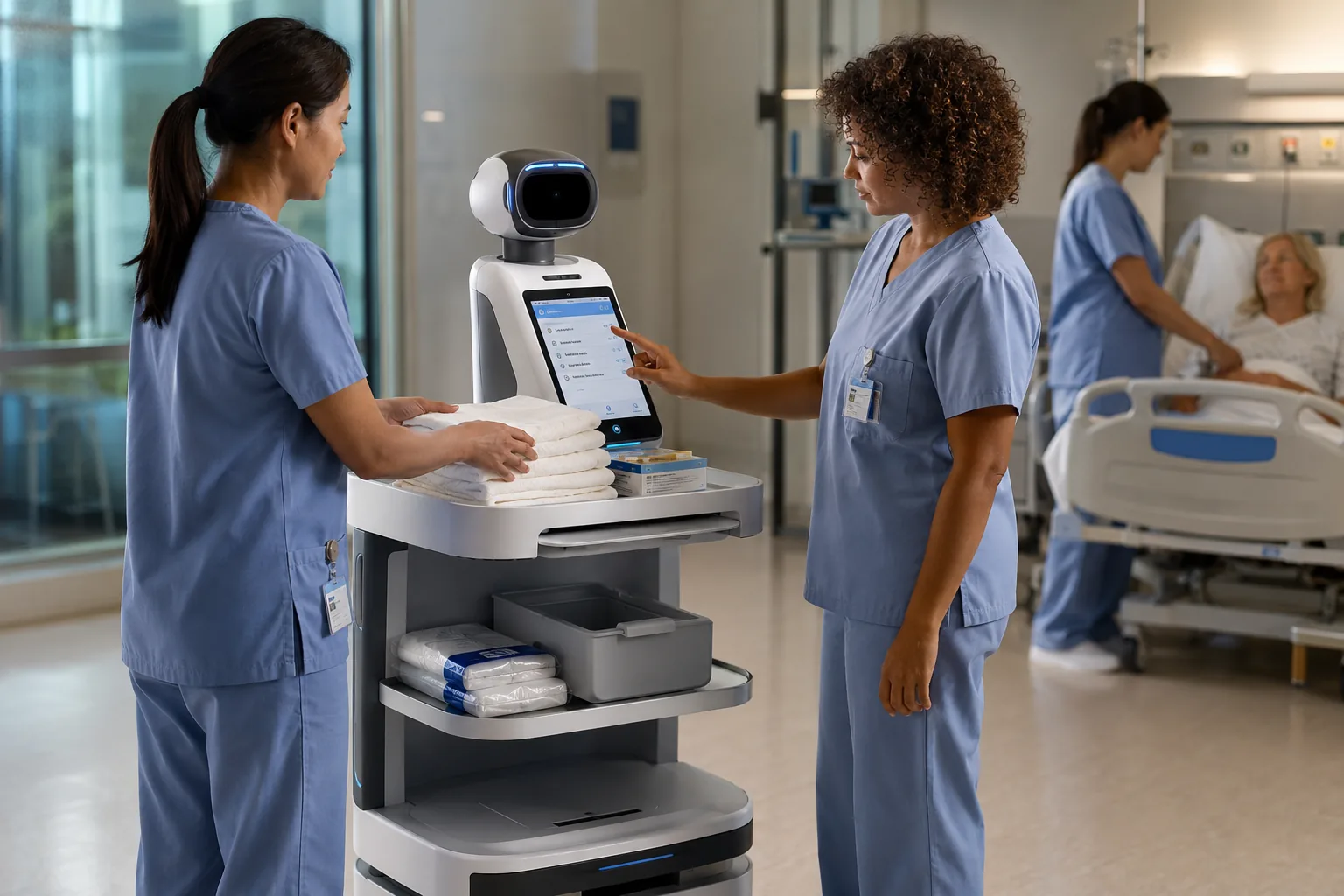 Concept visualisation
Overview
Genetix clinical and nursing-assistance robots support ward teams with defined, non-invasive tasks: transporting supplies and samples within the ward, bringing requested items, and supporting information and communication moments. Task scope is explicit and configured with the ward — these systems assist care; they do not deliver it.
Connected to the workflow layer, assistance robots receive tasks from the same processes the team already uses: a request on the ward board becomes a robot task, its status is visible to the team, and completion is recorded.
Healthcare context
A significant share of a nursing shift is spent walking, fetching and coordinating rather than caring. Assistance robotics can absorb part of that load — if it fits the ward's rhythm, behaves predictably around patients, and stays firmly in the non-clinical lane.
Intended users
- Nursing teams and ward coordinators
- Facility and logistics teams
- Clinical technology management
Availability and deployment options are confirmed as part of an initial consultation with our team.
Capabilities
What it provides
Defined ward-support tasks
Configured non-clinical tasks such as supply runs, item delivery and sample transport within the ward.
Safe movement among people
Navigation designed for corridors and ward spaces shared with patients, visitors and staff.
Team-visible task status
Requests, progress and completion visible in the team's workflow view.
Simple, appropriate interaction
Clear status display and straightforward interaction — deliberately without a humanoid persona.
Recorded task history
Completed tasks logged for coordination and review.
Example workflow
How it works in practice
- 1
A nurse requests supplies
The request is placed in the normal ward workflow and becomes a robot task.
- 2
The robot collects and delivers
The robot navigates to the supply point and delivers to the ward location, moving predictably among people.
- 3
The team sees status
Progress and arrival are visible on the ward's task view; the nurse stays with the patient.
- 4
Completion is recorded
Delivery confirmation closes the task in the workflow history.
Example workflow for illustration. Actual configurations are defined with each organisation and always keep qualified professionals in control of clinical decisions.
Integration
Part of a connected environment
Assistance robots operate through the workflow and integration layers: tasks originate in team workflows, and status and history live where the team already works.
Assistance robots extend the workflow layer into physical ward support and share fleet coordination with hospital logistics robotics.
Connects with
- Clinical and operational workflows
- Hospital logistics coordination
- Ward task views and history
Implementation
Introduced with care
Deployments begin with a ward-level task analysis: which tasks, which routes, which handover points. Pilots with the nursing team shape configuration before wider rollout; the ward keeps control over task scope.
Responsible use
- Task scope is explicitly non-clinical and configured with the care team.
- Robots never replace professional care contact; they free time for it.
- Movement and task behaviour are logged and reviewable.
Related
Explore further
Get in touch
Talk to our team about Nursing-Assistance Robots.
We can walk through the capability in the context of your organisation, your systems and your priorities.