
Medical Robotics
Hospital Logistics Robots
Autonomous internal transport that keeps hospitals supplied — scheduled, coordinated and traceable, around the clock.
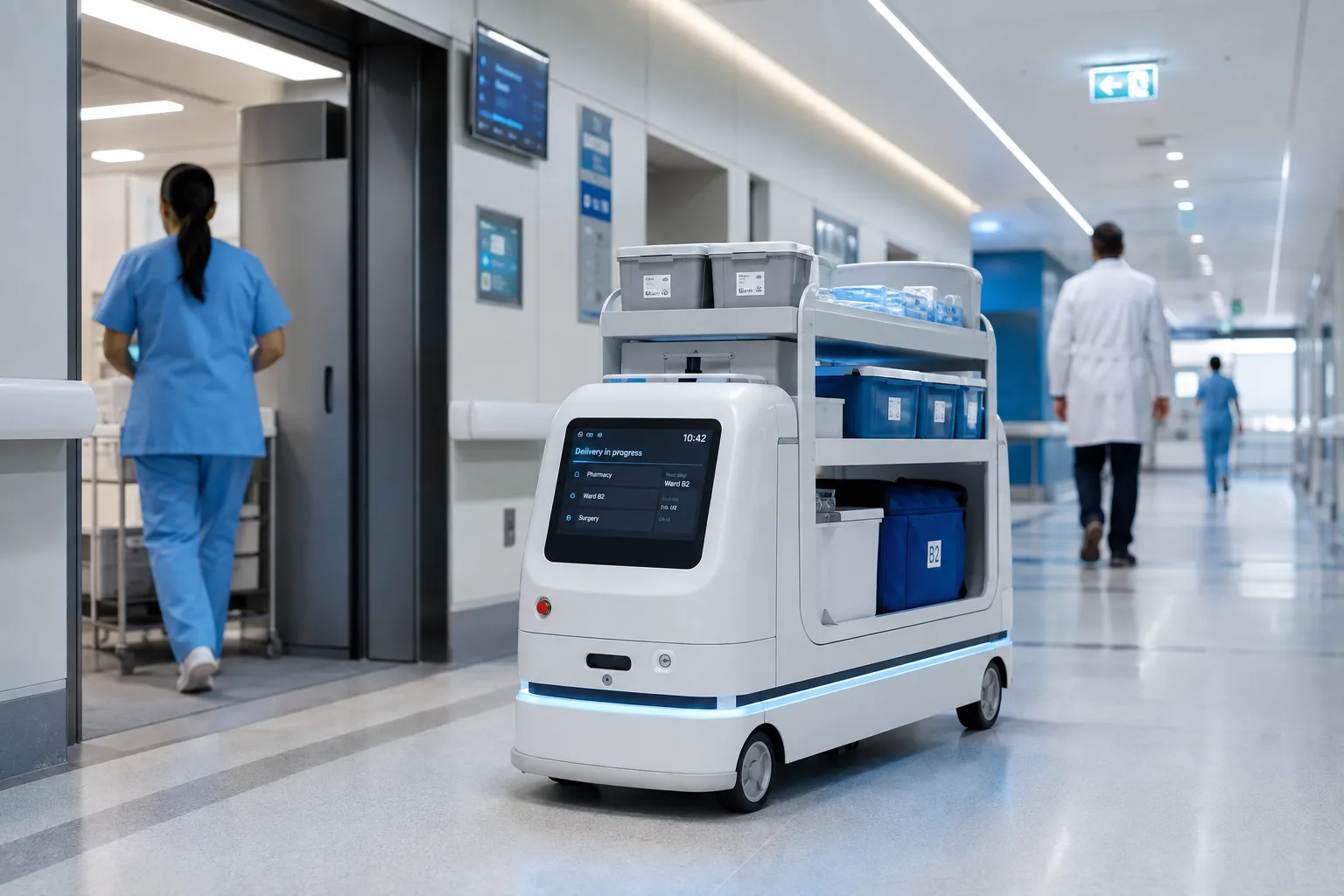 Concept visualisation
Overview
Genetix hospital logistics robots handle internal transport and delivery: sealed transport of goods between storage, departments and service points, on schedules and on demand. Fleet coordination assigns tasks, plans routes, manages lift and door interactions where infrastructure allows, and balances workload across robots.
Because logistics tasks originate in operational workflows — an ERP replenishment, a ward request, a scheduled round — every transport has a reason, an owner and a record. Operations teams see the fleet as part of their process, not as a separate system to babysit.
Healthcare context
A hospital is a continuous flow of goods: sterile sets, medication, linen, meals, samples. Moving them consumes staff hours and corridor space at the busiest times. Logistics robotics can carry this flow reliably — when it is planned as part of hospital operations, not as a gadget.
Intended users
- Hospital logistics and facility teams
- Ward coordinators
- Operations management
Availability and deployment options are confirmed as part of an initial consultation with our team.
Capabilities
What it provides
Sealed internal transport
Secure transport of goods in closed compartments between configured points.
Fleet coordination
Task assignment, route planning and workload balancing across the robot fleet.
Scheduled and on-demand tasks
Recurring rounds alongside ad-hoc requests from wards and departments.
Infrastructure interaction
Coordination with lifts, doors and charging as configured per building.
Operational visibility and history
Live fleet status for operations teams and a traceable transport history.
Example workflow
How it works in practice
- 1
A transport need arises
ERP replenishment or a ward request creates a transport task in the workflow layer.
- 2
The fleet coordinator assigns
The best-placed robot receives the task; the route is planned around current activity.
- 3
The robot transports
Goods travel sealed; the robot navigates shared corridors safely and predictably.
- 4
Delivery is confirmed and recorded
Receipt confirmation updates stock, workflow and history in one event.
Example workflow for illustration. Actual configurations are defined with each organisation and always keep qualified professionals in control of clinical decisions.
Integration
Part of a connected environment
Logistics robotics is driven by the workflow layer and connected to ERP, ward requests and building infrastructure through the integration platform.
Logistics robotics is where the ecosystem becomes visibly physical: ERP intent, workflow coordination and robotic execution meet in the corridor — with the record to prove it.
Connects with
- Healthcare ERP and inventory
- Ward and department workflows
- Building infrastructure (lifts, doors) as configured
- Operational analytics
Implementation
Introduced with care
Programmes assess building layout, flows and infrastructure, then phase deployment by route and department. Staff briefing and clear operating rules are part of every rollout.
Responsible use
- Robots operate within configured routes, speeds and operating rules.
- Transport of sensitive goods follows the organisation's handling policies.
- All movements and deliveries remain traceable.
Related
Explore further
Get in touch
Talk to our team about Logistics Robots.
We can walk through the capability in the context of your organisation, your systems and your priorities.